Exposure of Julius Enderby
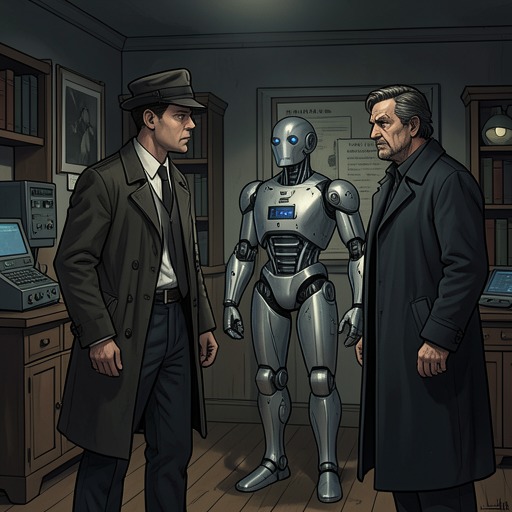
The Caves of SteelThe exposure of Julius Enderby turns a murder investigation into a reckoning with the institutions and loyalties that shaped it. Elijah Baley identifies the commissioner as Roj Nemennuh Sarton’s killer, traces how he manipulated the inquiry and the anti-robot unrest, and finally produces physical evidence linking Enderby to the murder. The case ends not with a simple arrest but with Enderby’s confession and a conditional promise to help the Spacers’ colonization project.
The trusted commissioner under suspicion
Baley explains that Enderby asked him to take the case instead of assigning it to a higher-ranking investigator because their college friendship made Baley less likely to suspect a trusted old companion and superior. Enderby also knew that Jessie Baley belonged to an underground organization and expected that knowledge could be used to divert Baley from the investigation or silence him if he came too close. The assignment itself thus becomes part of the alleged plan: the investigator’s loyalty and private vulnerability were meant to protect the person directing the inquiry.
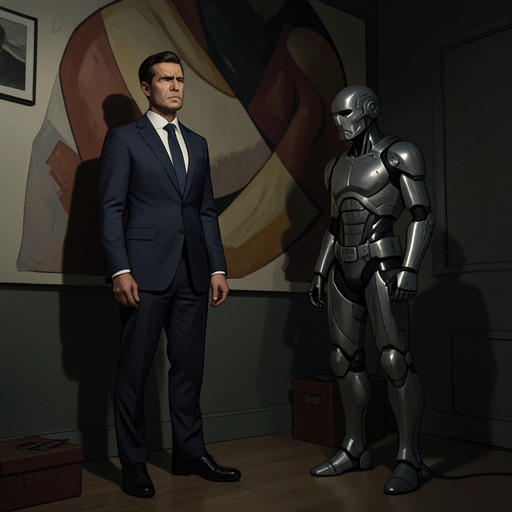
Enderby had a further advantage in controlling the investigation: he knew that Baley would react strongly to R. Daneel Olivaw, and tried from the outset to make the two work at cross-purposes. Baley presents these efforts not as incidental friction but as deliberate misdirection, calculated to make suspicion fall on Daneel rather than on the commissioner. Enderby’s professional authority and personal familiarity with Baley had allowed him to shape the investigation from inside it.
The informer and the staged unrest
The shoe-counter incident, initially read as evidence of widespread anti-robot feeling in the City, acquires a different meaning in Baley’s reconstruction. He argues that the Medievalists already knew Daneel was a robot: even Anthony Gerrigel, Earth’s leading robot expert, had not recognized Daneel at their first meeting until the subject of humanoid robots arose. It therefore seemed implausible to Baley that rioters, amid confusion and tension, could independently identify Daneel with such certainty that their organization would act on it.
Baley concludes that the shoe-counter disturbance was deliberately staged to demonstrate anti-robot hostility to Daneel and, through him, Spacetown. Its purpose was to blur individual responsibility by making the population as a whole appear culpable. Since Baley himself had not revealed Daneel’s identity and had ruled out Daneel as the source, the commissioner was the only other Earthman he knew had that information. Enderby counters that the Police Department might contain other spies, pointing to Jessie’s membership as a reason not to exclude that possibility. Baley rejects the appeal to unnamed suspects and insists on following the direct line of evidence to Enderby.
Reconstructing the murder
Baley’s explanation of the killing turns on the movement of the blaster and on the possibility that a robot could cross open country at night. He alleges that Enderby put a blaster into R. Sammy’s hand and directed him where and when to go. Enderby then entered Spacetown through the Personal, where his own blaster was taken from him, and received another weapon from K. Sammy. After killing Roj Nemennuh Sarton, Enderby returned the blaster to K. Sammy, who carried it back across the fields to New York City. Baley further alleges that Enderby later destroyed K. Sammy because the robot’s knowledge had become dangerous. This sequence accounts, in his view, for the commissioner’s presence at the scene and the missing weapon without requiring a human New Yorker to crawl a mile beneath the open sky at night.
The decisive physical clue appears in the image of the main door to Sarton’s dome. With the door slid open into its wall receptacle, two small glass fragments glitter in the runner grooves. Baley reconstructs the moment: Enderby was at the dome, nervous enough to remove and wipe his glasses, and dropped them; they broke, perhaps underfoot. When the door opened and a figure resembling Daneel appeared, Enderby fired, then gathered up the remains of his glasses and fled. The person he had killed was not Daneel but Sarton, who had designed Daneel in his own image.
The fragments turn a plausible reconstruction into tangible corroboration. Daneel identifies them as two slivers of glass and initially says they had seemed meaningless. Baley points out that they are pieces of concave lenses and asks that their optical properties be compared with Enderby’s present spectacles. He then takes the glasses from Enderby and hands them to Daneel as proof that the commissioner had been at the dome earlier than had been believed. A familiar, necessary object—Enderby’s spectacles—becomes incriminating when its broken pieces are found in the door track.
Confession and political bargain
Enderby’s resistance gives way under the accusation. As Baley’s watch reaches midnight and a new day begins, the commissioner lowers his head and says that the killing was a mistake and that he never meant to kill Sarton. He collapses from his chair, unconscious but not dead; Daneel says Baley has hurt him, and Baley answers that he had to press the case because he possessed inferences rather than evidence that would stand up in court. Baley says he deliberately released his case little by little, hoping to make Enderby break down, and asks Daneel to confirm that he heard the confession. Daneel does.
Baley then connects Enderby’s decision to the larger political stakes. He says the Spacers’ chief objective is the resumption of Galactic colonization, which they risk death by coming to Earth to pursue. If Sarton’s murder can help bring Medievalism into line with that purpose, the Spacers may regard the loss as a worthwhile sacrifice. Daneel confirms that he is speaking for Han Fastolfe and the Spacers generally when he offers to let the past be forgotten if Enderby helps them. The offer carries an explicit condition: if Enderby later betrays them, they can use his guilt against him. Enderby asks whether he will avoid prosecution, and Daneel answers that he will if he helps.
With tears in his eyes, Enderby agrees, still insisting that the killing was accidental and that he had acted as he thought right. Baley tells him that helping would now be the right course, arguing that space colonization is Earth’s only possible salvation and urging him to speak with Fastolfe if prejudice prevents him from accepting that case. His first requested act is immediate and practical: Enderby must quash the R. Sammy business, call it an accident or something, and end it. Baley also warns that harming him will not erase the truth, because Spacetown knows it as well. The exposure therefore concludes with the murderer’s guilt established and his power redirected toward the political project he had opposed or obstructed.